


Reviewed Date: 09/02/2026
✔ Medically Reviewed By: Naveed Javied, PT
Disclaimer: The information in this article is for educational purposes only and does not constitute medical advice, diagnosis, or treatment. Always consult a licensed healthcare professional or physical therapist regarding any rehabilitation program. Never disregard professional medical advice or delay seeking it because of content read here. Use of this information does not establish a patient-provider relationship.
Table of Contents
Undergoing spinal surgery flips your daily routine entirely upside down. Tasks you previously knocked out without a second thought—like hopping into a vehicle for a quick coffee run—suddenly require calculated precision. Patients often feel trapped at home, deeply anxious about injuring their healing spine. If you are preparing for a hospital discharge or an upcoming follow-up appointment, mastering the rules for traveling after back surgery by car is absolutely non-negotiable. One wrong twist under the heavy weight of your own body can trigger excruciating nerve pain or jeopardize a delicate lumbar fusion. This guide breaks down exactly what happens to your spine when you sit in a moving vehicle, how long you actually need to wait before driving, and the precise physical techniques required to keep your back safe on the road.
The Hidden Physics of Traveling After Back Surgery by Car
Look at the raw biomechanics of seated posture. Standing places a baseline, expected load on your lumbar discs. Sit down, and that pressure instantly spikes by up to 40 percent. The natural inward curve of the lower back flattens out. The discs suddenly bear the entire brunt of the upper body’s weight.
Now, place that seated body inside a moving vehicle. Engines vibrate continuously. Potholes send unpredictable shockwaves straight up through the chassis into the seat. Traffic forces sudden, jerky stops. When sitting in a car after back surgery, the spine absorbs every single low-frequency vibration and lateral sway. A healthy back handles this environmental stress effortlessly. A spine that just underwent a complex discectomy or laminectomy? It reacts with rapid inflammation, defensive muscle spasms, and severe nerve irritation.
Surgeons do not enforce travel restrictions just to be overly cautious. They do it because the mechanics of riding in a vehicle actively work against the tissue healing process if mismanaged.
The Passenger vs. Driver Divide During Traveling After Back Surgery by Car
Recovery rarely follows a perfectly straight line. A patient nursing a small microdiscectomy incision will naturally hit functional milestones weeks before someone recovering from an intensive, multi-level lumbar fusion. But across the board, medical protocols draw a massive distinction between riding as a passenger and operating a vehicle.
As a passenger, individuals typically get clearance for short, necessary trips almost immediately. You have to get home from the hospital somehow, after all.
Operating the vehicle presents a monumental leap in physical risk. Driving requires sharp, unhesitating reflexes. You must twist your neck and thoracic spine to check blind spots. Your right foot has to pivot instantly from the gas to the brake pedal in a split-second emergency. If your core muscles remain weak from surgery, or if a sudden jolt of sciatic pain shoots down your leg, you physically cannot stop the car fast enough.
Beyond the physical limitations, driving under the influence of prescription opioids or muscle relaxants isn’t just dangerous—it’s highly illegal. These medications severely blunt reaction times and spatial awareness.
| Type of Spinal Procedure | Passenger Guidelines (Short Trips) | Estimated Driver Clearance | Core Functional Milestone Required |
|---|---|---|---|
| Lumbar Discectomy / Laminectomy | Immediate (with precautions) | 2 to 4 weeks | Off all narcotics; entirely pain-free leg movement. |
| Single-Level Lumbar Fusion | Immediate (with precautions) | 4 to 6 weeks | Ability to sit completely comfortably for 30+ minutes. |
| Multi-Level Spinal Fusion | Immediate (frequent breaks needed) | 6 to 12 weeks | Clear radiographic evidence of solid bone healing. |
| Cervical (Neck) Fusion (ACDF) | Immediate (with precautions) | 2 to 6 weeks | Safe, fluid neck rotation for checking blind spots. |
(Note: These timelines serve purely as general medical estimates. Final driving clearance must always come directly from the operating surgeon.)
Ergonomics and Technique: Protecting the Spine
Knowing the timeline only gets you halfway to a successful recovery. The real everyday challenge lies in the mechanics of physically getting in and out of the vehicle.
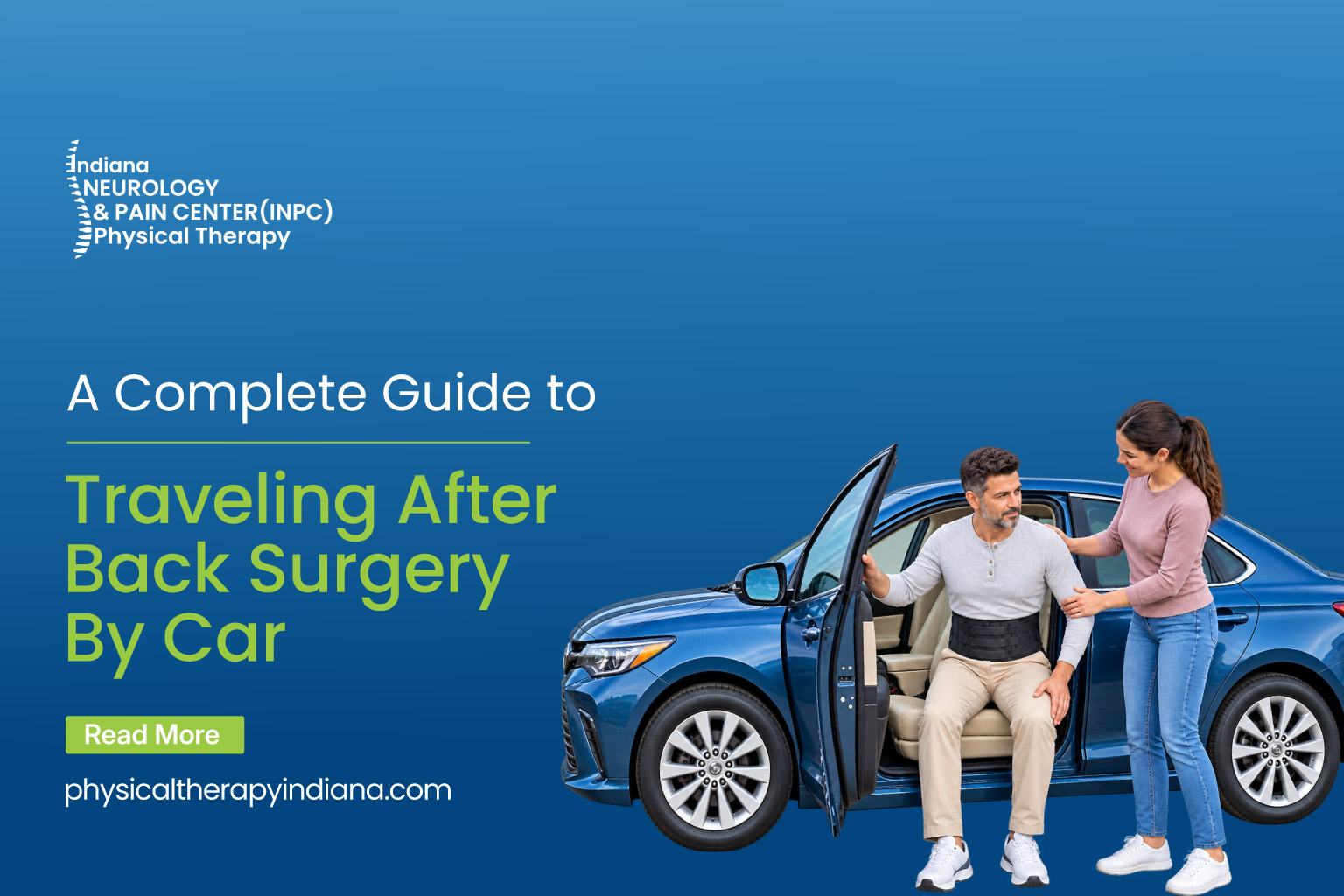
The single most dangerous maneuver anyone can make while traveling after back surgery by car is a combined bending and twisting motion. Twisting under load tears healing tissues and places extreme shear force on the discs. To bypass this entirely, patients must master a rigid movement called the “log-roll.”
Here is how to execute a safe vehicle entry:
- Walk backward toward the open car door until the back of your knees lightly touch the edge of the passenger seat.
- Reach back with your hands to grip the sturdy door frame or the dashboard.
- Lower your body straight down. Keep the spine completely rigid.
- Once seated sideways on the very edge of the seat, keep your knees glued tightly together.
- Pivot your entire body as one solid unit—just like a log—to face the windshield.
Reverse this exact process to exit.
| Essential Vehicle Gear | Medical Purpose for Post-Surgical Travel |
|---|---|
| Silk Pillowcase or Plastic Bag | Placed flat on the seat fabric. Creates a highly slippery surface, making the log-roll pivot practically frictionless. |
| Firm Lumbar Roll | Physically supports the inward curve of the lower back, reducing direct downward disc compression. |
| Seatbelt Adjuster | Routes the heavy belt away from fresh surgical incisions across the hip or abdomen, preventing painful friction. |
| Reclining Seatback (100–110 degrees) | Opens the hip angle. This specific angle offloads tension from the tight psoas muscles connected directly to the lumbar spine. |
Surviving a Long Car Ride After Back Surgery
A ten-minute hop to the pharmacy feels manageable. A multi-hour interstate journey requires militant planning. If a road trip after back surgery proves entirely unavoidable, patients must adhere strictly to the “45-Minute Rule.”
Every 45 to 60 minutes, the vehicle must pull over. The patient needs to log-roll out, stand up, and walk around for five to ten minutes. Why? Because prolonged immobility paired with recent surgical trauma skyrockets the risk of Deep Vein Thrombosis (DVT)—dangerous, potentially fatal blood clots in the legs. Frequent walking changes the mechanical load on the spine, gives compressed discs a much-needed break, and forces pooled blood to circulate back up through the calves.
Remember, traveling after back surgery by car should never be a test of endurance. Pain is a highly effective, biological warning signal. Ignore it, and the physical setbacks can be severe. Proper hydration and performing seated ankle pumps (pointing and flexing the toes) also go a long way in preventing circulatory issues during the drive.
Preparing for car travel after back surgery also involves strategic medication timing. For passengers, taking a prescribed anti-inflammatory about 30 to 45 minutes before departure ensures maximum pain relief right as the jarring road vibrations begin. Drivers must rely strictly on cleared, non-impairing methods like ice packs. (Ice generally outperforms heat in the early recovery weeks, as it numbs sharp nerve pain and aggressively reduces sitting-induced swelling).
Reclaiming the Driver's Seat Without the Danger

Naveed Javied, PT
Physical Therapist
Naveed Javied is a highly skilled physical therapist specializing in orthopedic rehabilitation. He earned his Doctor of Physical Therapy from the University of Montana, building upon his Master of Physical Therapy from Quinnipiac College. With extensive clinical experience, including specialized orthopedic care at Oakwood Annapolis Hospital, Javied focuses on helping patients effectively manage pain and restore their mobility.
Frequently Asked Questions
Under no circumstances. Even if the surgical site feels fantastic, prescription muscle relaxers crush your reaction times. They heavily dull motor reflexes and fog up basic cognitive functions. Getting behind the wheel while using these medications is strictly illegal. More importantly, it turns any driver into a massive liability on the highway, completely independent of how good the spine actually feels that day.
The front passenger seat wins every single time. It offers vastly superior legroom, allows the backrest to recline to that ideal 100-110 degree angle, and makes the log-roll entry significantly easier compared to climbing into a cramped, awkward back seat.
Yes. Hours stuck in a rigid seated position, combined with relentless highway bumps, will often anger the sciatic nerve. This flare-up usually triggers a dull, nagging ache or a brief wave of pins-and-needles radiating down one leg. Fortunately, lying flat with a good ice pack almost always resolves the annoyance. Watch out for red-flag symptoms, though. If unexpected leg weakness hits hard, or if bladder and bowel control suddenly vanishes, get to an emergency room right away.
While general timelines suggest anywhere from two to eight weeks, only the operating surgeon gets to make that official call. They will evaluate bone healing via X-ray, check reflex times, and verify the total absence of narcotic medications before finally handing over the keys.
References
https://my.clevelandclinic.org/health/procedures/10895-laminectomy
https://www.hopkinsmedicine.org/health/treatment-tests-and-therapies/opioids