

Date: 08/17/2026
Medically Reviewed By: Naveed Javied, PT
Disclaimer: The information in this article is for educational purposes only and does not constitute medical advice, diagnosis, or treatment. Always consult a licensed healthcare professional or physical therapist regarding any rehabilitation program. Never disregard professional medical advice or delay seeking it because of content read here. Use of this information does not establish a patient-provider relationship.
Table of Contents
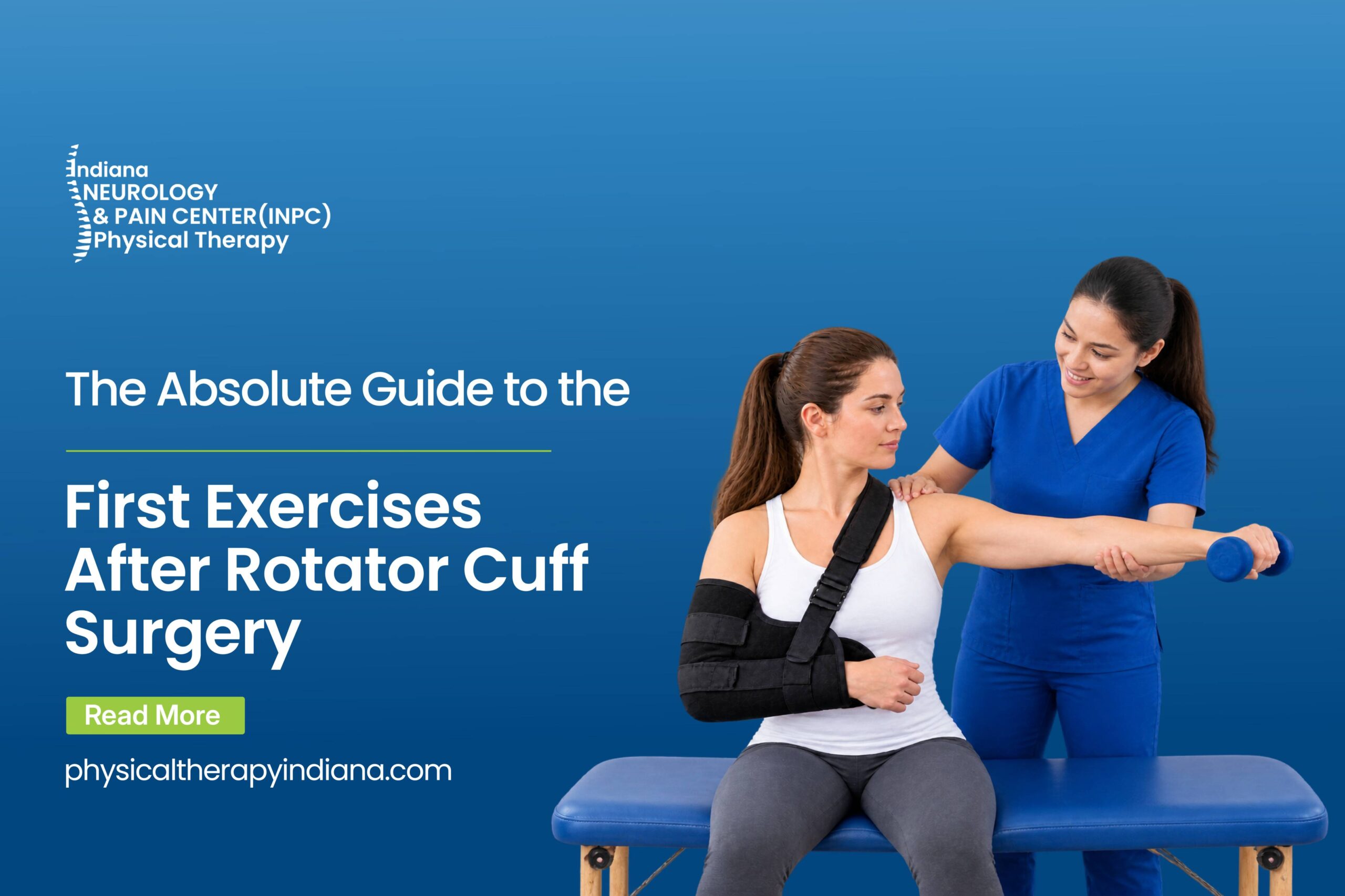
Waking up from shoulder repair surgery is an incredibly distinct experience. The nerve block usually keeps the pain away for the first few hours, but there is always a heavy, unfamiliar bulk strapped to the torso. That is the immobilizer sling. Most patients immediately wonder what happens next. They ask the nurses. They ask the surgeon. Everyone wants to know exactly when to start the first exercises after rotator cuff surgery. Eagerness to move is entirely normal. Nobody likes feeling trapped in a brace. But the timeline for shoulder rehabilitation after surgery is dictated strictly by biology, not willpower. Tendons take a notoriously long time to heal back to bone. It requires an exact sequence of specific movements to prevent debilitating stiffness without ripping the fresh surgical anchors right out of the humerus.
Why Timing Matters for the First Exercises After Rotator Cuff Surgery
The shoulder joint is fundamentally unstable by design. It is often compared to a golf ball sitting precariously on a small wooden tee. The rotator cuff isn’t just one single structure holding it together. It consists of four distinct muscles—the supraspinatus, the infraspinatus, the teres minor, and the subscapularis. They wrap around the head of the upper arm bone to keep that “golf ball” centered during movement.
When one or more of these tendons tear away from the bone, a surgeon has to go in, clear out the damaged frayed tissue, and sew the tendon back onto the humerus using tiny plastic or metal anchors. The body registers this as massive trauma. Inflammation immediately floods the joint capsule.
If an individual attempts active exercise after shoulder surgery too early, the mechanical pull of the firing muscle will violently yank on those tiny anchors. The result? A catastrophic re-tear. Conversely, leaving the arm completely immobile for weeks leads to adhesive capsulitis—a condition widely known as frozen shoulder. Internal scar tissue acts like superglue inside the joint space.
This creates a delicate biological tightrope. The joint must move to stop scar tissue from forming, but the muscle itself absolutely cannot fire or pull. This paradox is solved by relying entirely on passive range of motion. Passive motion dictates that the patient’s own shoulder muscles exert zero effort. Another person, a machine, or gravity does all of the actual lifting.
| Post-Operative Phase | Timeframe | Biological Focus | Permitted Joint Movement |
|---|---|---|---|
| Phase I (Max Protection) | 0 to 4 Weeks | Anchor integration, acute inflammation control | True Passive ROM only (no active muscle firing) |
| Phase II (Mod Protection) | 4 to 6 Weeks | Early tendon maturation, capsule stretching | Active-Assisted ROM (AAROM) |
| Phase III (Early Strength) | 6 to 12 Weeks | Neuromuscular re-education, fluid mechanics | Active ROM, Sub-maximal Isometrics |
| Phase IV (Advanced) | 3+ Months | Muscle hypertrophy, dynamic joint stability | Progressive resistance, plyometrics |
Phase I Details and the First Exercises After Rotator Cuff Surgery
The initial four weeks are undeniably the most frustrating part of the entire recovery process. Sleep is routinely terrible. Finding a comfortable position in the sling feels impossible. Showering and getting dressed require elaborate, one-handed gymnastics. During this window, rotator cuff surgery exercises are limited entirely to highly controlled passive movements.
A physical therapist will typically introduce the first exercises after rotator cuff surgery within a few days of the operation. The most universal starting point is the pendulum swing.
To do a pendulum safely, the patient bends forward at the waist. The hand of the non-operative arm is placed firmly on a table or countertop for support. The surgical arm then drops down toward the floor, hanging like dead weight. Using only the momentum of the torso rocking back and forth or in small circles, the hanging arm gently sways. The shoulder muscles remain completely shut off. It looks wholly unimpressive. It feels highly uncoordinated at first. Yet, this simple gravity-assisted motion bathes the joint cartilage in synovial fluid and stops the joint capsule from contracting.
Other passive movements in phase I involve the therapist manually lifting the arm while the patient lies flat on their back. Lifting the arm in the scapular plane—roughly 30 degrees forward of the side of the body—protects a delicate supraspinatus repair while ensuring the joint doesn’t lock up.
Progressing the Protocol: Month One and Beyond
Hitting the one-month mark brings a noticeable psychological and physical shift in the rehabilitation strategy. The tendon is finally starting to lay down stronger, thicker collagen fibers over the surgical site. The anchors are getting buried in new tissue.
4 Weeks Post Op Rotator Cuff Surgery Exercises
At this stage, the protocol normally shifts into Active-Assisted Range of Motion (AAROM). The 4 weeks post op rotator cuff surgery exercises are designed to let the dormant muscles wake up gently, but they still receive heavy mechanical help.
Think of it like training wheels on a bicycle. The patient is pedaling, but they aren’t bearing the full load of the physical effort. A classic example is the pulley system. Sitting in a straight-backed chair beneath a door-mounted rope pulley, the patient uses their healthy arm to pull down, which slowly drags the surgical arm up into forward flexion.
Another common tool is a PVC pipe, a broomstick, or a lightweight wooden cane. Holding the cane horizontally with both hands, the healthy arm drives the movement. It pushes the injured arm outward to stretch into external rotation. Table slides are also introduced here. The patient sits at a table, places a slippery towel under their hand, and slides the arm forward across the surface. The table supports the weight of the limb while the joint stretches out.
6 Weeks Post Op Rotator Cuff Surgery Exercises
Six weeks is the magic number for the vast majority of orthopedic protocols. This is usually when the surgeon officially clears the patient to ditch the immobilizer sling during the day.
The 6 weeks post op rotator cuff surgery exercises graduate to true Active Range of Motion (AROM). This means lifting the arm against the weight of gravity using only the shoulder’s own intrinsic power. It sounds incredibly simple, but patients are often shocked by how obscenely heavy a normal human arm feels after a month and a half of disuse. The deltoid muscle has forgotten how to fire properly. Often, people try to “shrug” their upper trapezius muscle up to their ear just to get their hand above chest level.
Physical therapists watch like hawks for this compensatory shrugging. Perfect mechanics matter infinitely more than height. If the scapula isn’t setting correctly against the ribcage, raising the arm will just grind the newly repaired tendon against the acromion bone overhead, causing severe inflammation.
Rebuilding Power and Dynamic Stability
Once a patient can actively elevate their arm without sharp pain and without horrible shrugging mechanics, the focus transitions to building actual strength. This is where dedicated rotator cuff physical therapy exercises come heavily into play. Muscle atrophy is highly visible by this point. The arm looks noticeably smaller than the healthy side.
| Exercise Category | Muscle Group Targeted | Execution Note | Typical Progression Timeline |
|---|---|---|---|
| Sub-maximal Isometrics | Deltoid, Rotator Cuff | Pushing against a wall with zero joint movement | 6 to 8 Weeks |
| Scapular Retraction | Rhomboids, Trapezius | Pinching shoulder blades together without resistance | 4 to 8 Weeks |
| Supine Punches | Serratus Anterior | Lying down, pushing fist directly toward the ceiling | 8 to 10 Weeks |
| Internal/External Rotation | Infraspinatus, Subscapularis | Using light resistance bands anchored at waist level | 10 to 12+ Weeks |
Isometric holds are the starting line for generating muscular power safely. The joint doesn’t actually move during an isometric contraction. You simply stand next to a solid surface, like a wall, and gently push your wrist outward against the drywall. You hold that static tension for a few seconds and release. It forces the muscle fibers to fire without dragging the tendon across the bone.
By months three and four, the shoulder surgery recovery exercises get substantially harder. Light resistance bands are introduced for internal and external rotation. Dumbbells make an appearance. Therapists utilize rhythmic stabilization drills—a process where the patient holds their arm straight up in the air while the therapist gently taps or pushes it in random directions, forcing the rotator cuff to stabilize against unpredictable forces.
A lot of people ask if they can just rush back to the gym by month three. They feel decent, so they try to skip the tedious early phases, completely forgetting that the first exercises after rotator cuff surgery laid the microscopic foundation for the tendon to handle heavy loads. Going back to bench pressing or heavy overhead lifting too soon is a guaranteed ticket back to the operating room.
Effective exercises after rotator cuff repair require a specific, unyielding progression. You simply cannot load a dysfunctional joint and expect it to hold together.
Wrapping Up the Recovery Process

Naveed Javied, PT
Physical Therapist
Naveed Javied is a highly skilled physical therapist specializing in orthopedic rehabilitation. He earned his Doctor of Physical Therapy from the University of Montana, building upon his Master of Physical Therapy from Quinnipiac College. With extensive clinical experience, including specialized orthopedic care at Oakwood Annapolis Hospital, Javied focuses on helping patients effectively manage pain and restore their mobility.
Frequently Asked Questions
The exact timeline is heavily dependent on the operating surgeon’s specific protocol. However, true passive movements like pendulums often begin within 48 to 72 hours following the operation. The goal is to safely mobilize the joint capsule without engaging the actual muscles. Active, unassisted movement is strictly forbidden until the 4 to 6 week mark in nearly all cases.
There is a massive, highly important difference between a dull, aching stretch and a sharp, stabbing pain. It is completely normal for the shoulder to ache aggressively after physical therapy sessions. Tissues are being stretched. Tight scar tissue is being remodeled. However, sharp, tearing sensations or electric shocks are a giant red flag. Rehabilitation should always live in the realm of manageable discomfort, never excruciating agony.
Not for a long time. For the first month, most people have to sleep in a recliner chair propped up with pillows to keep the arm from falling backward and stressing the surgical repair. Sleeping flat on your back in a normal bed is notoriously painful early on because gravity pulls the heavy humerus bone down into the mattress, aggressively stretching the front of the joint capsule.
Bone-to-tendon healing is incredibly slow and metabolically expensive. While a person might be able to drive a car and type on a keyboard at 8 weeks, maximum medical improvement for massive tears can take upwards of a full year. Returning to high-level throwing sports or heavy manual labor takes significant time and dedication to the strength phases of rehab.
References
Effects of maximal vs. submaximal isometric fatiguing exercise on subsequent submaximal exercise performance.
J Strength Cond Res. 2020;34(7):1875-1883. Accessed August 13, 2026.
https://pubmed.ncbi.nlm.nih.gov/31145388/
Rehabilitation after rotator cuff repair.
Open Orthop J. 2017;11:154-162. Accessed August 13, 2026.
https://pmc.ncbi.nlm.nih.gov/articles/PMC5366376/