
Reviewed Date: 09/02/2026
✔ Medically Reviewed By: Naveed Javied, PT
Disclaimer: The information in this article is for educational purposes only and does not constitute medical advice, diagnosis, or treatment. Always consult a licensed healthcare professional or physical therapist regarding any rehabilitation program. Never disregard professional medical advice or delay seeking it because of content read here. Use of this information does not establish a patient-provider relationship.
Table of Contents
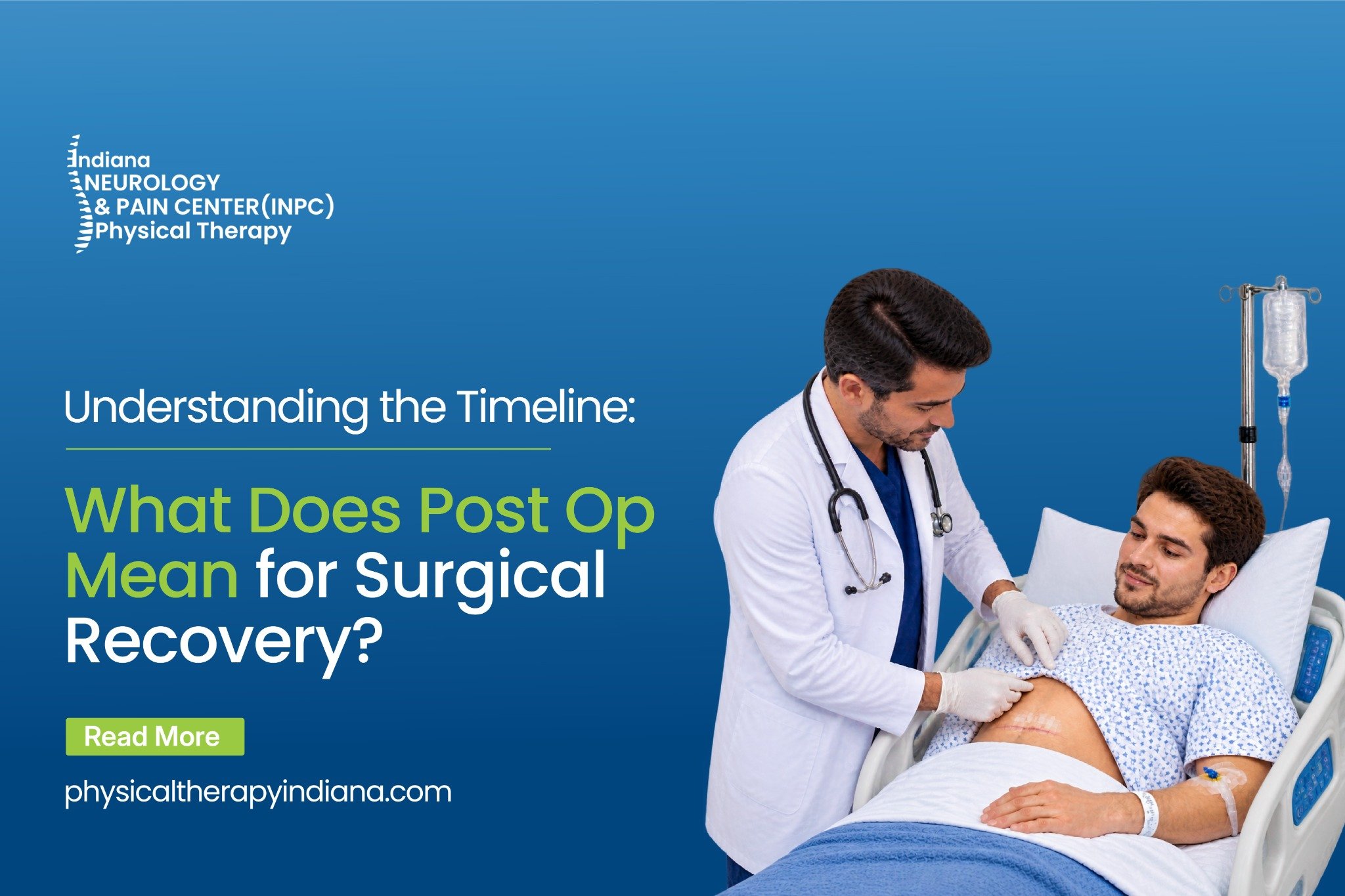
A hospital discharge packet usually arrives as a thick stack of confusing paperwork. Patients read the forms, pause, and inevitably ask: exactly what does post op mean for the days ahead? It sounds like simple clinical shorthand. Yet, the reality spans far beyond waking up groggy in a recovery bay. Grasping the true definition of post surgery care requires looking at cellular repair, pain cycles, and gradual mobility. It is a biological marathon. Let’s break down the phases.
The Medical Viewpoint: What Does Post Op Mean in a Clinical Setting?
Medical charts rely heavily on fast terminology. The prefix ‘post’ is Latin for ‘after.’ The word ‘op’ serves as an industry abbreviation for an operation. Put them together, and you have a heavily monitored window of time controlled by doctors and nurses.
When surgeons seek to define post surgery protocols, they aren’t looking at a calendar. They track oxygen saturation, blood pressure, and tissue integrity. They look at biological markers. This is the post op meaning medical teams prioritize across hospital wards. They want immediate stabilization. So, what is postoperative care in this acute setting? It’s the strict oversight that kicks in the very second the anesthesia drip stops.
Families waiting nervously in the lobby often hear quick updates from a surgical nurse and immediately wonder, what do post op mean for taking the patient home safely? Early instructions dictate absolutely everything. Weight-bearing limits. Showering rules. Incision checks. Medication timing. Nothing is left to chance.
Moving Past the Hospital: The Everyday Post Surgery Meaning
Leaving the hospital shifts the entire landscape. The sterile environment disappears. Suddenly, everyday tasks become strategic missions. Getting out of bed requires rolling onto one side to spare stitched abdominal muscles. Putting on socks demands a plastic reacher tool to avoid bending the hips past ninety degrees.
The true post surgery meaning surfaces during these quiet, frustrating moments at home. To truly understand what is post op, one must look at daily routine modifications. Tissues require mechanical tension to heal properly. Pushing too hard, however, can easily tear fragile stitches wide open. Finding that strict balance—knowing exactly when to rest the body and when to actively challenge it—dictates the entire pace of recovery.
How the Body Heals: Three Distinct Milestones
Physical trauma does not resolve at random. The human system actually follows a highly specific sequence, shifting away from a loud, painful inflammatory reaction all the way down to a quiet, months-long tissue remodeling process. Healing does not happen overnight.
Phase 1: The Inflammatory Stage
This starts immediately. When the scalpel makes an incision, the body’s immune system rushes to the site. Nearby blood vessels clamp down hard to halt the bleeding initially. Moments later, they dilate wide open, creating a massive rush of immune cells directly into the surgical site. The result? Sudden swelling, noticeable heat, and a bright red color that frequently panics individuals. However, this inflammation is actually the body cleaning the wound of cellular debris.
Phase 2: The Proliferative Stage
Starting a few days later, the body starts rebuilding. Fibroblasts begin laying down new collagen fibers. New blood vessels form. The wound physically starts to pull itself closed.
Phase 3: The Remodeling Stage
This lasts for months. Sometimes a full year. The initial, messy scar tissue reorganizes. It aligns along lines of physical stress to become stronger.
Table 1: Biological Stages of Surgical Rehabilitation
| Healing Stage | Cellular Action | Visible Symptoms | Typical Timeframe |
|---|---|---|---|
| Inflammatory | White blood cells flood the site to prevent infection. | Swelling, localized heat, acute pain, redness. | Day 1 to Day 6 |
| Proliferative | Fibroblasts lay down new, disorganized collagen. | Granulation tissue forms, wound edges contract. | Day 4 to Day 24 |
| Remodeling | Collagen fibers align and strengthen. | Scar flattens, joint mobility improves, pain fades. | 3 weeks to 12+ months |
Core Priorities During the Healing Window
Controlling pain is not just about keeping a patient comfortable. It is a biological necessity. Unchecked pain spikes blood pressure, triggers anxiety, and completely ruins sleep patterns. Modern surgical teams favor multimodal pain management. They mix nerve blocks, anti-inflammatory drugs, and targeted ice therapy. Why? To keep patients moving without relying heavily on high-dose narcotics.
Movement prevents blood clots. It expands the lungs. Patients constantly ask, what does post op mean when it comes to strict bed rest? It rarely means staying completely still. In fact, prolonged bed rest actively destroys muscle mass and stiffens joint capsules. Getting up and walking, even just to the kitchen, forces blood back to the heart and prevents deep vein thrombosis (DVT).
Incision integrity matters just as much. The surgical wound acts as the only barrier keeping dangerous pathogens out of the bloodstream. Discharge instructions explicitly detail how to wash. Usually, this means letting soapy water run over the wound without scrubbing. Clinicians want to see clear or slightly pink drainage. Thick, cloudy, or foul-smelling fluid is an immediate red flag.
Table 2: Common Care Tasks and Physiological Objectives
| Post-Surgical Task | Clinical Requirement | Biological Purpose |
|---|---|---|
| Incision Care | Sterile dressing changes. Keep site dry. | Prevents site infection. Protects fragile sutures. |
| Respiratory Drills | Use incentive spirometer 10x per hour. | Re-expands collapsed lung tissue to prevent pneumonia. |
| Ankle Pumps | Active movement of feet in bed. | Forces venous blood return to prevent dangerous clots. |
| Hydration/Nutrition | High protein intake. Heavy water consumption. | Provides amino acids needed for cellular repair. |
Physical Therapy and Progressive Mobility
A successful operation corrects an anatomical defect. A broken bone is pinned. A torn ligament is anchored. But surgery does not automatically restore muscle coordination. It does not fix joint mechanics.
Prolonged resting causes rapid muscle atrophy. Without movement, scar tissue forms in a chaotic, restrictive web. Physical therapists step in to rebuild movement mechanics. While a surgeon fixes the physical structure, a therapist ensures the central nervous system remembers how to use it.
When looking at a joint replacement timeline, what does post op mean for exercise protocols? It means progressive loading. Tendons and ligaments only regain their baseline tensile strength when subjected to controlled, calculated resistance. Therapists start with passive range of motion. They move the limb for the patient. Once the incision fully closes and the internal anchors hold, the patient begins active resistance. Skipping this phase guarantees long-term stiffness.
Safe Steps Toward Long-Term Restoration

Naveed Javied, PT
Physical Therapist
Naveed Javied is a highly skilled physical therapist specializing in orthopedic rehabilitation. He earned his Doctor of Physical Therapy from the University of Montana, building upon his Master of Physical Therapy from Quinnipiac College. With extensive clinical experience, including specialized orthopedic care at Oakwood Annapolis Hospital, Javied focuses on helping patients effectively manage pain and restore their mobility.
Frequently Asked Questions
Perioperative is the broad umbrella term encompassing the entire surgical journey from start to finish. Intraoperative covers the exact window inside the operating room while the patient is under anesthesia. Postoperative refers strictly to the recovery period that begins the moment the surgery finishes.
Yes. A sudden body temperature spike hitting 101°F or higher requires an immediate call to a physician. Other massive red flags include sudden shortness of breath, escalating pain that ignores medication, spreading red streaks around the incision margins, or localized calf pain that feels unusually warm.
The timeline varies drastically. A minor soft tissue biopsy might require only two weeks of healing. In contrast, complex orthopedic reconstructions—like spinal fusions or total knee replacements—often demand a highly structured rehabilitation window lasting anywhere from six months to over a year before maximum medical improvement is reached.
During the initial inflammatory phase, ice is the standard recommendation. Cold therapy constricts blood vessels, which actively drives down swelling and numbs localized nerve endings. Heat draws blood to the area, which can actually increase throbbing and swelling in fresh incisions. Always follow the specific instructions provided by the surgical team.
References
https://www.ncbi.nlm.nih.gov/books/NBK470443/
https://my.clevelandclinic.org/health/articles/9445-diaphragmatic-breathing