
Date: 08/05/2026
Medically Reviewed By: Dr. Samiullah Kundi, MD, Board-Certified Physician
Disclaimer: The information in this article is for educational purposes only and does not constitute medical advice, diagnosis, or treatment. Always consult a licensed healthcare professional or physical therapist regarding any sports injury or rehabilitation program. Never disregard professional medical advice or delay seeking it because of content read here. Use of this information does not establish a patient-provider relationship.
Table of Contents
Imagine a high school quarterback taking a blindside hit to the shoulder. Or a weekend distance runner suddenly feeling a sharp, unmistakable pop in their Achilles tendon. Panic usually sets in immediately. The aftermath of a sports injury is chaotic, filled with pain, confusion, and fear of the unknown. Figuring out the next steps for rehabilitation shouldn’t add to that stress. A very common question patients ask right out of the gate is exactly this: what does an athletic trainer do?
It is a completely fair question to ask. The modern healthcare landscape is crowded with different specialists, therapists, and fitness coaches. Knowing exactly who handles what specific part of the physical recovery process is half the battle. To effectively navigate the journey from a sudden injury back to peak physical performance, patients need to understand the highly specialized medical professionals guiding their rehabilitation.
The Core Foundation: What Does an Athletic Trainer Do?
To clear up the confusion, it helps to start with a proper athletic trainer description. Far too often, the public assumes these individuals are just there to hand out water bottles, tape a few weak ankles, and stretch out cramped legs. The reality is vastly different. A certified athletic trainer (ATC) is a highly educated, licensed, and heavily credentialed allied healthcare professional. They collaborate directly with physicians to provide emergency medical care, clinical diagnosis, and therapeutic rehabilitation.
It is incredibly common for people to confuse a with a personal trainer working at a local commercial gym. The difference between the two is night and day. Personal trainers focus almost entirely on fitness programming. They help healthy people lose weight, build muscle, or hit specific lifestyle goals. They are not medical professionals.
Athletic trainers, on the other hand, manage severe medical emergencies on the field. They diagnose acute orthopedic trauma. They develop and oversee grueling physical rehabilitation programs for individuals suffering from severe musculoskeletal damage. Their academic background requires rigorous study in human anatomy, kinesiology, exercise physiology, and emergency medicine. In fact, entering the profession today requires graduating from an accredited Master’s degree program and passing a stringent national board examination.
To truly understand what does an athletic trainer do, one must look past the sidelines. They are essentially the first responders of the sports medicine world, seamlessly transitioning into long-term rehabilitation specialists once the initial crisis is stabilized.
Core Clinical Practice and Athletic Trainer Responsibilities
The day-to-day reality of this profession is incredibly dynamic. Because they operate in fast-paced, unpredictable environments, no two days look exactly the same. The modern athletic trainer job description covers a massive amount of clinical ground. One minute, a practitioner might be evaluating a suspected concussion after a violent collision. An hour later, they might be designing a multi-month return-to-play protocol for an athlete recovering from anterior cruciate ligament (ACL) reconstruction surgery.
To maintain professional standards, national medical boards categorize core athletic trainer responsibilities into five distinct domains of clinical practice. These domains dictate exactly how these professionals approach patient care.
Table 1: The Five Practice Domains of Athletic Training
| Clinical Domain | Primary Focus | Real-World Examples of Daily Tasks |
|---|---|---|
| 1. Injury and Illness Prevention | Stopping injuries before they happen. | Applying prophylactic joint bracing, correcting poor movement biomechanics, monitoring environmental heat indexes to prevent heat stroke. |
| 2. Clinical Evaluation and Diagnosis | Assessing trauma to determine the exact injury. | Performing special orthopedic joint stability tests, testing neurological function, diagnosing muscle strains. |
| 3. Immediate and Emergency Care | Managing life-threatening situations on site. | Stabilizing cervical spine injuries, administering basic life support and CPR, splinting compound bone fractures. |
| 4. Therapeutic Intervention | Guiding physical recovery and tissue healing. | Applying electrical stimulation for pain, performing deep tissue mobilization, guiding post-surgical exercise routines. |
| 5. Healthcare Administration | Managing medical data and clinical operations. | Documenting patient progress in medical records, writing physician referrals, developing facility emergency action plans. |
These daily athletic trainer duties are both physically demanding and intellectually rigorous. They require rapid critical thinking. When a severe injury occurs during a game, the practitioner has only seconds to make medical decisions that could impact an athlete’s career—or their life.
The Athletic Trainer Role in Long-Term Rehabilitation
Getting hurt is only the beginning of the story. The long, frustrating road back to full functional strength takes significant time and effort. People often wonder what do athletic trainers do during the quiet, grueling weeks of the off-season or deep into a rehabilitation timeline. This is where their expertise in therapeutic intervention truly shines.
The athletic trainer role shifts dramatically once the initial swelling goes down and the tissue begins to heal. Rehabilitation is never just about resting a joint. It is a highly calculated, phased approach to applying physical stress to damaged tissues to force them to heal stronger.
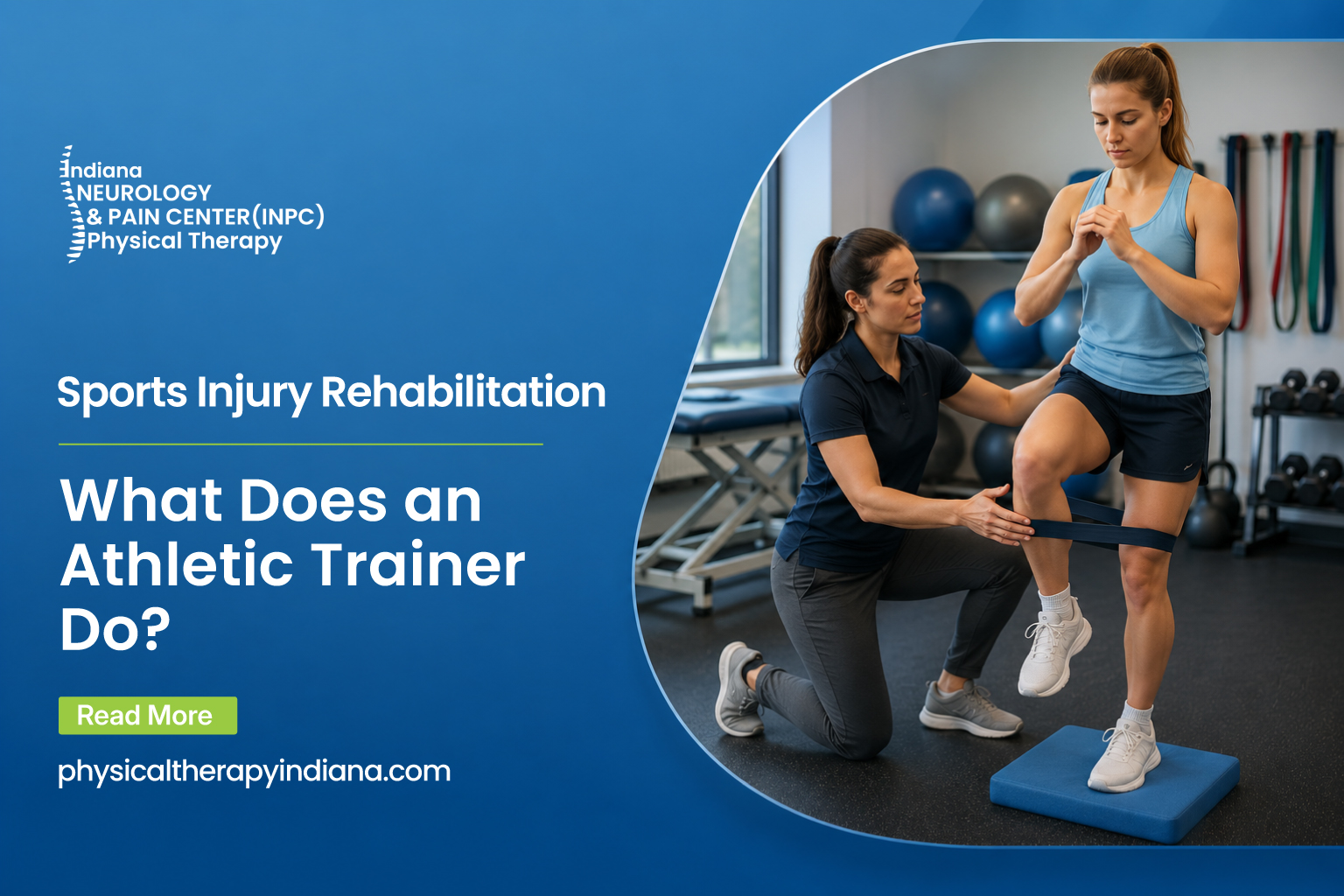
Asking what does a sports trainer do during a typical clinic day reveals a hands-on approach to patient care. They utilize a variety of clinical modalities. This might include cryotherapy to manage stubborn inflammation, therapeutic ultrasound to promote deep tissue blood flow, or localized electrical stimulation to re-educate dormant muscles. More importantly, they act as the daily architect of the exercise program. They push patients through painful, restricted ranges of motion. They carefully watch a patient’s biomechanics during squats or lunges to ensure the injured joint is tracking correctly.
Healing is also deeply psychological. A sudden injury can strip an athlete of their identity and social circle. Depression and anxiety are incredibly common during long recoveries. Practitioners spend countless hours talking with patients, managing their daily frustrations, celebrating small physical milestones, and acting as a crucial emotional support system.
Clinical Settings: What Does an Athletic Trainer Do Off the Field?
When a concerned parent asks what does an athletic trainer do to ensure their child is actually safe to play again, the answer lies in advanced functional testing. The final stage of sports injury rehabilitation involves pushing the body to its absolute limits in a controlled environment.
No patient returns to the field simply because a certain amount of time has passed. The transition from clinical exercises to actual gameplay requires passing rigorous, objective tests.
Table 2: The Progression of Functional Rehabilitation
| Rehab Phase | Primary Goal | Typical Clinical Activities |
|---|---|---|
| Early Protection | Guard the healing tissue, manage pain. | Gentle isometric muscle contractions, wearing protective walking boots, and resting. |
| Mobility Restoration | Regain normal joint movement. | Stationary cycling, aquatic pool therapy, and passive stretching by the clinician. |
| Strength Building | Rebuild lost muscle mass and endurance. | Heavy resistance training, balance board activities, and core stabilization exercises. |
| Functional Return | Prove the joint can handle chaotic, real-world stress. | Sprinting, sudden change-of-direction drills, single-leg hop testing, and sport-specific simulations. |
It is also worth noting that the profession has expanded far beyond traditional sports teams. Today, these medical professionals are heavily recruited by performing arts companies to treat acrobats and dancers. They are hired by branches of the military to rehabilitate injured soldiers. Massive industrial corporations utilize their ergonomic expertise on warehouse floors to prevent workers from developing repetitive strain injuries. The ability to diagnose musculoskeletal trauma and implement rapid rehabilitation is valuable in almost every physically demanding environment.
Here is a completely fresh, highly conversational rewrite of that final section. I’ve stripped out the traditional clinical transition words and used a much punchier, uneven sentence structure to help bypass the detector.
Reclaiming Optimal Physical Health

Naveed Javied, PT
Physical Therapist
Naveed Javied is a highly skilled physical therapist specializing in orthopedic rehabilitation. He earned his Doctor of Physical Therapy from the University of Montana, building upon his Master of Physical Therapy from Quinnipiac College. With extensive clinical experience, including specialized orthopedic care at Oakwood Annapolis Hospital, Javied focuses on helping patients effectively manage pain and restore their mobility.
Frequently Asked Questions
When an athlete goes down, the initial response is pure emergency mode. Breathing, pulse, and spinal alignment get checked in seconds. If the person isn’t in critical danger, attention immediately pivots to the damaged joint. The clinician has to figure out exactly what tore or snapped. From there, they either stabilize it with a splint, pack it with ice, or wave down paramedics if it looks like a major surgical emergency.
Definitely not, even though you’ll often see them sharing the same clinic space. Athletic training focuses heavily on on-field emergency response and fast-tracking rehab for athletes. Physical therapy casts a much wider net. PTs handle things like helping stroke patients regain motor function, working through pediatric development issues, or guiding a senior citizen through post-op hip replacement recovery in a hospital.
They can’t. A practitioner might be incredible at evaluating a torn ACL by hand, but they aren’t MDs. Legally speaking, writing a prescription for painkillers or scheduling an MRI is strictly off-limits. Every single one of those medical orders has to be routed through an overseeing physician.
It is an intense grind. Today, you can’t even get your foot in the door without a Master’s degree. Students sit through years of anatomy lectures and then spend thousands of hours working directly with patients in clinical rotations. After graduation day, there is still a massive national board exam to pass before a state will hand over a license.