


Date: 09/02/2026
Medically Reviewed By: Naveed Javied, PT
Disclaimer: The information in this article is for educational purposes only and does not constitute medical advice, diagnosis, or treatment. Always consult a licensed healthcare professional or physical therapist regarding any rehabilitation program. Never disregard professional medical advice or delay seeking it because of content read here. Use of this information does not establish a patient-provider relationship.
Table of Contents
Waking up in the recovery room with a bulky brace locked from thigh to ankle usually brings one immediate, pressing question to mind. For anyone staring down months of physical therapy, knowing exactly how long after ACL surgery can you walk is the ultimate benchmark of getting life back to normal.
That first month is undeniably a grind. The leg feels incredibly heavy, pain medications cause brain fog, and simply making it to the bathroom feels like an Olympic event. But understanding the true ACL surgery recovery timeline—from those wobbly first steps on crutches to finally trusting the joint without a second thought—makes the mental battle much easier to handle.
The Initial Shock: How Long After ACL Surgery Can You Walk With Assistance?
Right after the nerve block wears off—usually around the 24 to 36-hour mark—the leg feels like a completely dead weight. Patients often call it “log leg.” Because of the massive surgical trauma, the brain’s signals to the quadriceps are blocked by fluid and swelling in a frustrating process called arthrogenic muscle inhibition. At this stage, the priority isn’t speed. It’s about protecting the newly installed graft and aggressively fighting inflammation.
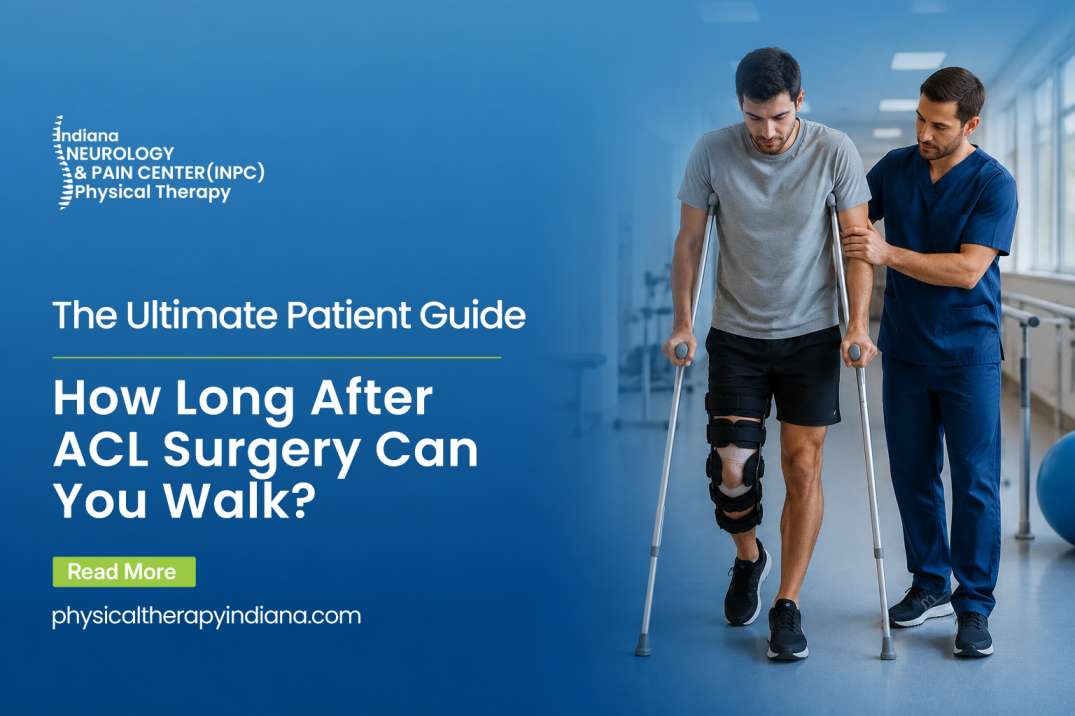
Surgeons generally allow partial weight-bearing almost immediately if the procedure was a straightforward, isolated reconstruction. This means putting a little bit of weight through the foot while relying heavily on crutches for balance and safety. However, if a meniscus repair was thrown into the mix, the rules change drastically. A repaired meniscus often dictates strict toe-touch weight-bearing—or none at all—for up to four to six weeks to protect the delicate stitches holding the cartilage together.
Milestones to Ditch the Crutches: How Long After ACL Surgery Can You Walk Unassisted?
For a standard, uncomplicated repair, the ACL surgery recovery time to walk unassisted usually lands right around the two-to-four-week mark. Ditching the crutches entirely doesn’t happen just because a certain number of days have passed on a calendar. Physical therapists look for very specific functional checkpoints before giving the green light.
- Reaching true zero degrees of knee extension (getting the leg perfectly straight).
- Swelling must be visibly reduced and manageable.
- Performing a straight leg raise without the knee bucking or sagging (no “extension lag”).
- Demonstrating enough quad control to absorb body weight without a compensatory limp.
Once the thigh muscle wakes up and can properly stabilize the joint, the crutches get left behind. But doing this too early can easily backfire. Walking with a severe limp forces the hips and lower back to overcompensate, which usually leads to secondary muscle spasms and joint pain.
Understanding the ACL Surgery Recovery Stages
Healing a reconstructed ligament isn’t just about waiting for an incision site to close up and fade. The newly implanted tissue goes through a complex biological transformation called ligamentization. The body literally breaks down the graft tissue and rebuilds it cell by cell into a living ligament. Because of this internal remodeling, the knee often feels fantastic at week eight, even though the graft itself is actually at its weakest point physically.
Breaking down the ACL surgery recovery by week helps manage expectations during those highly frustrating early days of rehab.
Table 1: Early Mobility and Clinical Milestones
| Timeframe | Clinical Focus & Mobility | Key Milestones to Hit |
|---|---|---|
| Weeks 1-2 | Swelling control, crutches, and a locked knee brace. | Achieve full 0° extension; perform a straight leg raise without lag. |
| Weeks 2-4 | Weaning off crutches, transition to a normal heel-to-toe gait. | Flexion reaches 90°-110°; walking without a visible limp. |
| Weeks 4-6 | Unassisted walking, start of closed-kinetic chain exercises. | Flexion over 120°; navigating stairs with alternating feet. |
Navigating Employment: How Long After ACL Surgery Can You Walk?
Getting off the couch and back on the payroll is usually the next major source of anxiety. Patients constantly ask their surgical teams: when can I return to work after ACL surgery?
Figuring out the ACL surgery recovery time off work depends entirely on the physical demands of the job, the daily commute, and current pain medication schedules. Trying to push through an eight-hour shift too soon usually results in massive fluid pooling in the lower leg and a throbbing joint by lunchtime.
For desk workers, the timeline for how long off work after ACL surgery is relatively short. Most people sitting at a computer can manage to log in from home within a few days, or return to an office environment in 7 to 14 days. The strict requirements here are being completely off narcotic pain medications (so driving is safe and legal) and having a practical setup to elevate the leg above the heart during the workday.
On the other hand, the ACL surgery return to work schedule for teachers, nurses, retail staff, or restaurant workers is significantly longer. Being on your feet all day requires the joint to handle sustained compression without ballooning up. These professionals usually need four to eight weeks before they can safely survive a busy shift.
For heavy manual labor—like construction, firefighting, or warehouse logistics—the timeline pushes deep into the three-to-six-month territory, demanding advanced strength clearance and agility testing before stepping back on the job site.
Table 2: Real-World Occupational Timelines
| Job Type | Real-World Examples | Estimated Time Off | What You Need to Go Back |
|---|---|---|---|
| Sedentary / Desk | Software engineer, accountant, writer | 1 to 2 Weeks | Off narcotic pain meds; a safe way to commute; ability to elevate the leg. |
| Light/Medium Physical | Teacher, retail staff, floor nurse | 4 to 8 Weeks | Walking entirely unassisted; ability to stand for hours without severe swelling. |
| Heavy Manual Labor | Construction worker, firefighter, mechanic | 3 to 6 Months | High-level strength and stability; medical clearance for heavy lifting and pivoting. |
The Long Game: ACL Reconstruction Recovery Time
The ACL surgery recovery time doesn’t magically end once normal walking resumes. While asking how long after ACL surgery can you walk is a completely valid early focus, the reality is that rebuilding total leg strength takes up to a full year.
Months two and three involve intense closed-kinetic chain exercises. Therapists introduce leg presses, step-downs, and balance board work to regain proprioception—the joint’s subconscious awareness of exactly where it is in space. By month four, if clinical strength tests reach at least 70% of the uninjured leg, a controlled running progression usually begins on an anti-gravity treadmill or a soft track.
The final phase from month six to twelve is all about sport-specific cutting, pivoting, and psychological readiness. Kinesiophobia—the intense, lingering fear of re-injury—is a massive mental hurdle during this stage. Anyone wondering how long after ACL surgery can you walk with total, subconscious confidence should know it often takes a solid six months to stop actively overthinking every single step taken on a wet floor, uneven grass, or an icy sidewalk.
Conclusion: Getting Back on Your Feet

Naveed Javied, PT
Physical Therapist
Naveed Javied is a highly skilled physical therapist specializing in orthopedic rehabilitation. He earned his Doctor of Physical Therapy from the University of Montana, building upon his Master of Physical Therapy from Quinnipiac College. With extensive clinical experience, including specialized orthopedic care at Oakwood Annapolis Hospital, Javied focuses on helping patients effectively manage pain and restore their mobility.
Frequently Asked Questions
Most people can walk normally—meaning no limp, no brace, and a completely natural heel-to-toe stride—between four and six weeks post-op. Limping for too long can trigger secondary hip or lower back pain, which is why physical therapists prioritize proper gait mechanics over rushing to drop the crutches. If you are still dragging the leg, you still need the crutches.
Putting full weight on a leg before the quadriceps muscle is firing properly can cause the knee to buckle suddenly. This puts dangerous mechanical stress on the healing graft. If a meniscus repair was also done, early weight-bearing can easily rip the delicate sutures holding the cartilage together, which usually means an immediate trip back to the operating room.
Putting full weight on a leg before the quadriceps muscle is firing properly can cause the knee to buckle suddenly. This puts dangerous mechanical stress on the healing graft. If a meniscus repair was also done, early weight-bearing can easily rip the delicate sutures holding the cartilage together, which usually means an immediate trip back to the operating room.
Regaining full, zero-degree knee extension is the absolute most critical milestone in the first two weeks. If the knee heals in a slightly bent position, scar tissue forms inside the joint (a condition called arthrofibrosis). This permanently limits mobility and makes it physically impossible to ever walk with a normal gait. You can get the bend back later, but extension has a strict, unforgiving deadline.
References
https://pmc.ncbi.nlm.nih.gov/articles/PMC4004131/
https://my.clevelandclinic.org/health/diseases/16576-acl-tear