
Reviewed Date: 09/15/2026
✔ Medically Reviewed By: Naveed Javied, PT
Disclaimer: Always seek the advice of your physician, physical therapist, or other qualified healthcare provider with any questions you may have regarding a medical condition, chronic pain, or before starting any new rehabilitation, exercise, or nutritional program. Never disregard professional medical advice or delay in seeking it because of something you have read in this article.
Table of Contents
Anyone who has spent time recovering from a severe joint injury usually hits the exact same roadblock. You put in the hard work at the gym, doing endless repetitions to build your muscle tissue back up. But the second you step awkwardly on an uneven sidewalk, the joint still buckles or feels completely unsupported.
The missing link in many of these recovery journeys is the vital connection between the brain and the body. Raw muscle strength is practically useless if your central nervous system cannot trigger those fibers to fire the exact millisecond you slip or stumble. Fixing this disconnect requires a completely different approach to physical therapy. Pushing heavy weights isn’t enough; the real work involves teaching the brain how to manage the body all over again.
The Physiology of Neuromuscular Training
To understand why traditional exercise often falls short for injury recovery, you have to look at how the human body actually processes movement.
Surrounding every major joint in the body is a dense network of mechanoreceptors. Think of these tiny nerve endings as built-in movement sensors. Their whole purpose is to keep your brain in the loop. They send a nonstop stream of updates letting you know if your arm is fully extended, if a calf muscle is tight, or exactly where your foot is positioned in space. Medical professionals refer to this physical self-awareness as proprioception.
When you step off a curb unexpectedly, these sensors instantly shoot a warning signal to the brain. The brain processes this data and fires a signal back down to the surrounding muscles, commanding them to contract and brace the joint before a ligament can tear. This entire sensorimotor loop happens in milliseconds.
Following a trauma such as an ACL tear, a severe ankle sprain, or the slow onset of degenerative joint disease, this communication pathway gets disrupted. The movement sensors become sluggish. The brain’s response time lags.
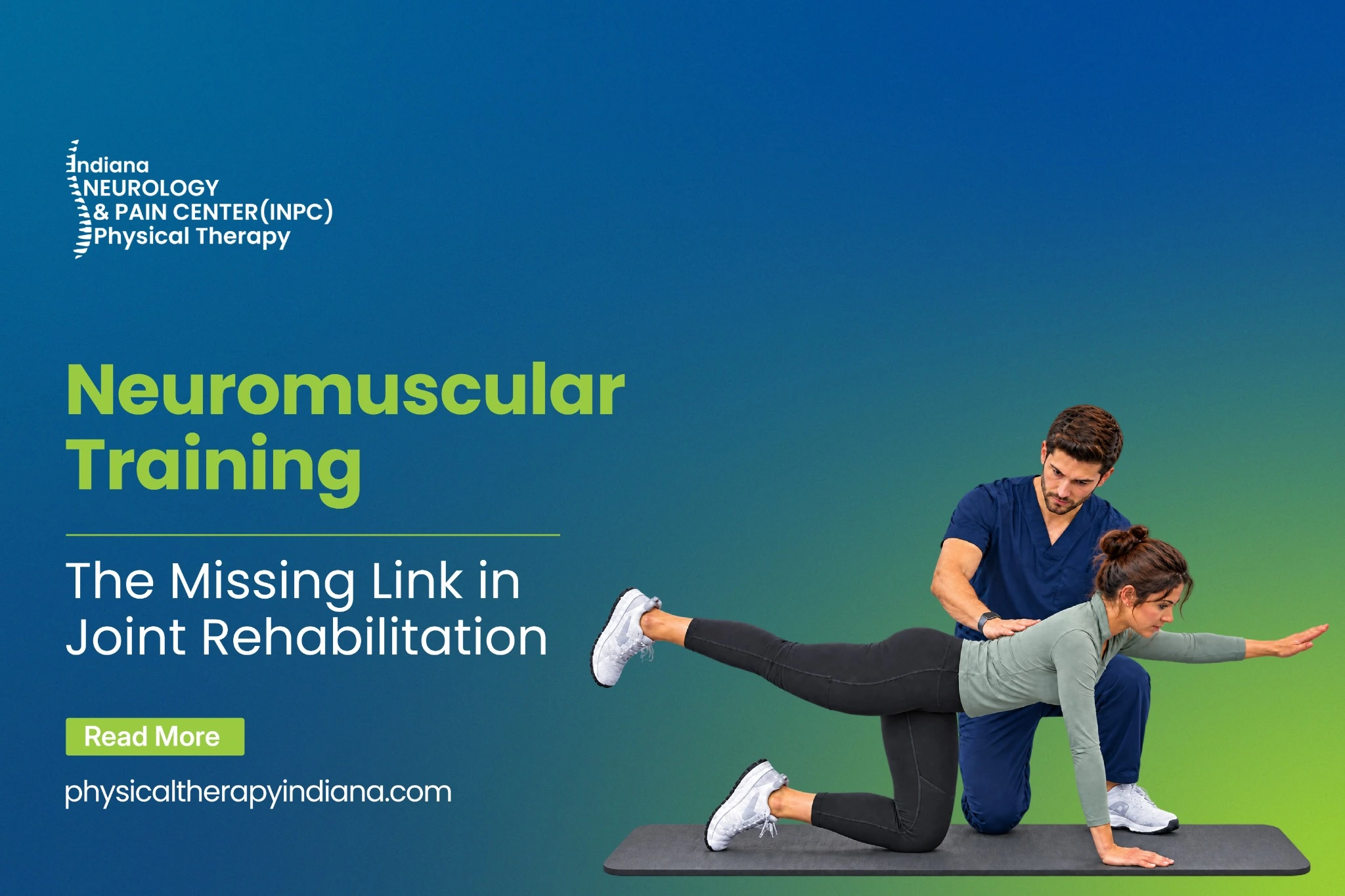
A neuromuscular training exercise program is designed to repair this exact neurological delay. It intentionally places the patient in controlled, unstable environments that force the nervous system to adapt, react, and fire efficiently. The clinical goal is not muscle hypertrophy (growth). The goal is neuromuscular coordination—teaching the brain how to orchestrate complex muscle firing patterns so movement becomes smooth, automatic, and safe.
How Brain-Focused Therapy Alters Joint Mechanics
It helps to visually separate this approach from the standard weightlifting routines you might see in a commercial gym. The methodologies serve entirely different physiological purposes.
Traditional strength training generally isolates muscle groups to increase sheer force output. Neuromuscular training focuses entirely on the quality and timing of movement.
Table 1: Traditional Hypertrophy vs. Neuromuscular Conditioning
| Focus Area | Traditional Strength Training | Neuromuscular Training |
|---|---|---|
| Primary Clinical Goal | Increase muscle fiber cross-sectional area and absolute force production. | Improve joint stability, movement mechanics, and sensorimotor reaction times. |
| Mental Focus Required | Minimal. You mostly repeat the same motion on a fixed path. | Intense. You have to actively concentrate to stay balanced as the environment shifts around you. |
| Execution Environment | Stable, fixed surfaces (weight benches, leg extension machines, flat floors). | Unstable, reactive surfaces (foam pads, Bosu balls, single-leg dynamic stances). |
| Movement Speed | Typically slow, rhythmic, and highly controlled under heavy load. | Highly variable. Includes sudden deceleration, rapid changes of direction, and static holds. |
| Ideal Patient Outcome | Improved metabolic health and raw lifting power. | Fall prevention, restored kinetic confidence, and delayed joint replacement surgeries. |
Clinical Applications and Patient Benefits
Because it fundamentally alters how the body absorbs physical stress, training the neuromuscular system yields profound benefits across a remarkably wide spectrum of medical conditions.
The NEMEX Protocol for Osteoarthritis
Perhaps the most heavily researched application is in the conservative management of hip and knee osteoarthritis. For decades, patients with degenerative joint disease were simply told to rest or given heavy pain medication.
Patients with severe arthritis often develop micro-instabilities. Because the cartilage is worn down, the joint shifts slightly during walking, causing intense pain. Through highly specific movements, the NEMEX protocol trains the tissues around a damaged joint to switch on faster and hold tighter. It essentially builds a shock-absorbing corset made of muscle right over the painful area. Long-term tracking indicates that improving sensorimotor control can delay the need for total joint replacement surgery by several years.
Athletic Protection and ACL Preservation
On the opposite end of the physical spectrum, neuromuscular exercises are non-negotiable for athletes. The anterior cruciate ligament (ACL) rarely tears because a player lacks leg strength. It tears due to a sudden breakdown in neuromuscular coordination.
When an athlete lands from a jump or abruptly cuts across the field, the nervous system must instantly command the glutes and hamstrings to absorb the force. If the brain is too slow to send that signal, the knee collapses inward, placing catastrophic shear force directly on the ligament. Sports medicine programs utilize intense neuromuscular drills to hardwire safe landing mechanics into the athlete’s brain so the body automatically corrects dangerous joint alignments before a tear can occur.
Overcoming Post-Surgical Muscle Inhibition
Following a major orthopedic surgery, the nerve endings around the surgical site are disrupted. This causes “muscle inhibition,” where the brain temporarily forgets how to recruit the muscles effectively. Targeted therapy and neuromuscular training protocols are essential to wake up these dormant pathways and restore full, confident mobility.
Progression Strategies in Neuromuscular Training
A good program never throws someone right into tough balancing acts on day one. Specialists break the recovery down into manageable stages. They slowly turn up the difficulty as the nerve endings start waking up.
Table 2: Clinical Progression of Neuromuscular Exercises
| Rehabilitation Phase | Exercise Example | Primary Neurological Objective |
|---|---|---|
| Phase 1: Standing Still (Static Control) | Balancing on one leg while standing on a squishy pad, sometimes with eyes closed. | Gets the sleepy nerve endings in the foot and ankle to start sending signals again. Taking away eyesight makes the brain rely completely on feeling the joint. |
| Phase 2: Moving Under Control | The Y-Balance drill, where someone stands on one foot and reaches the other leg out in different directions. | Shifts the center of gravity. It makes the hip and core muscles work hard to keep the pelvis straight while the person is distracted by reaching. |
| Phase 3: Landing Safely | Dropping off a small box and stopping instantly in a squat. | Wires the nervous system to fire the leg muscles the second the feet hit the ground. This takes the impact off the bones and joints. |
| Phase 4: Quick Reactions | Shuffling side-to-side based on random cues from a therapist. | Forces the brain to keep the knees and hips perfectly lined up even during messy, unexpected movements. |
Bridging the Gap in Modern Recovery

Naveed Javied, PT
Physical Therapist
Naveed Javied is a highly skilled physical therapist specializing in orthopedic rehabilitation. He earned his Doctor of Physical Therapy from the University of Montana, building upon his Master of Physical Therapy from Quinnipiac College. With extensive clinical experience, including specialized orthopedic care at Oakwood Annapolis Hospital, Javied focuses on helping patients effectively manage pain and restore their mobility.
Frequently Asked Questions
Neural adaptations happen surprisingly fast—much faster than the time it takes to build physical muscle mass. Since this approach fixes the body’s internal wiring rather than waiting for muscle fibers to grow, the benefits tend to show up surprisingly fast. Most people start feeling noticeably more grounded, sure-footed, and in control of their movements after just three to four weeks of regular sessions.
Neural adaptations happen surprisingly fast—much faster than the time it takes to build physical muscle mass. Since this approach fixes the body’s internal wiring rather than waiting for muscle fibers to grow, the benefits tend to show up surprisingly fast. Most people start feeling noticeably more grounded, sure-footed, and in control of their movements after just three to four weeks of regular sessions.
Yes. In fact, it is arguably the most effective intervention available for fall prevention in older adults. Geriatric programs strip away the high-impact jumping and focus heavily on low-impact proprioceptive drills. By improving the speed at which an older adult’s brain senses a loss of balance, they gain the critical milliseconds needed to catch themselves before a fall actually happens.
No exercise can regenerate destroyed cartilage. However, neuromuscular conditioning dramatically changes how physical loads are distributed across the damaged joint. By forcing the surrounding musculature to absorb the impact of walking or climbing stairs, the bone-on-bone friction is drastically reduced. That is exactly why folks often experience a massive drop in their daily aches and pains, even if an X-ray shows that the underlying cartilage wear and tear is still there.
References
https://pmc.ncbi.nlm.nih.gov/articles/PMC5488851/
https://www.mayoclinic.org/diseases-conditions/acl-injury/symptoms-causes/syc-20350738