
Reviewed Date: 09/15/2026
✔ Medically Reviewed By: Naveed Javied, PT
Disclaimer: Always seek the advice of your physician, physical therapist, or other qualified healthcare provider with any questions you may have regarding a medical condition, chronic pain, or before starting any new rehabilitation, exercise, or nutritional program. Never disregard professional medical advice or delay in seeking it because of something you have read in this article.
Table of Contents
An ankle sprain heals. A surgically repaired ACL eventually anchors into the bone. Torn rotator cuffs scar over and knit themselves back together. But even after the physical tissues mend, patients often face a frustrating reality: the injured joint just doesn’t feel right. It gives way unexpectedly. It aches after a short walk. It feels uncoordinated, clumsy, and weak.
This happens because physical trauma does more than tear muscle and ligament. It actively scrambles the neurological software running those tissues.
When a joint sustains damage, the localized swelling and pain essentially sever the communication lines between the affected area and the brain. The central nervous system loses its real-time 3D map of the limb. To protect the body, the brain immediately creates compensatory movement habits—limping, hiking a hip, or shifting weight. Over time, these bad habits become hardwired.
Halting this dysfunctional loop demands a highly specific clinical intervention. Looking at specific neuromuscular reeducation exercises examples, it becomes clear that true recovery isn’t just about building muscle. It is about restoring the delicate, lightning-fast dialogue between the brain and the body.
The Science of Neuromuscular Reeducation Exercises
Standard resistance training aims to make muscle fibers larger and stronger. Neuromuscular reeducation, on the other hand, targets the nervous system. Therapy centers entirely on refining how well, exactly when, and in what specific order those muscle fibers fire.
Every joint capsule and ligament is packed with specialized sensory receptors called proprioceptors. Think of them as microscopic GPS trackers. They constantly send data to the brain regarding how much tension a muscle is under, the exact angle of a joint, and the speed at which a limb is moving. When an injury damages these receptors, the brain flies blind.
Through highly specific neuromuscular training exercises, physical therapists force the nervous system to wake up. By placing patients in safe but challenging physical environments, clinicians can stimulate undamaged receptors to take over for the damaged ones, essentially rewiring the brain’s motor cortex.
Table 1: Strength Training vs. Neuromuscular Re-education
| Feature | Traditional Strength Training | Neuromuscular Reeducation |
|---|---|---|
| Primary Goal | Increase muscle size, power, and physical endurance. | Rebuilding static balance, subconscious reflex speed, and joint security. |
| System in Focus | Structural musculoskeletal tissues (like raw muscle mass and tendon strength). | Central and peripheral nervous systems. |
| Movement Type | Often single-plane and predictable (e.g., bicep curls, leg press). | Multi-planar, unpredictable, and functional. |
| Typical Tools | Dumbbells, barbells, heavy resistance machines. | Balance boards, foam pads, perturbation bands, tactile cues. |
Core Neuromuscular Reeducation Exercises Examples
Because movement dysfunction looks different for a stroke survivor compared to an athlete recovering from knee surgery, neuromuscular therapy exercises are highly varied. They generally fall into four distinct categories, progressively challenging the patient’s coordination.
1. Restoring Balance and Proprioception
Before anyone can run or jump safely, they have to be able to balance without relying on their eyesight. These neuromuscular exercises for balance strip away visual crutches and force the joints to do the heavy lifting.
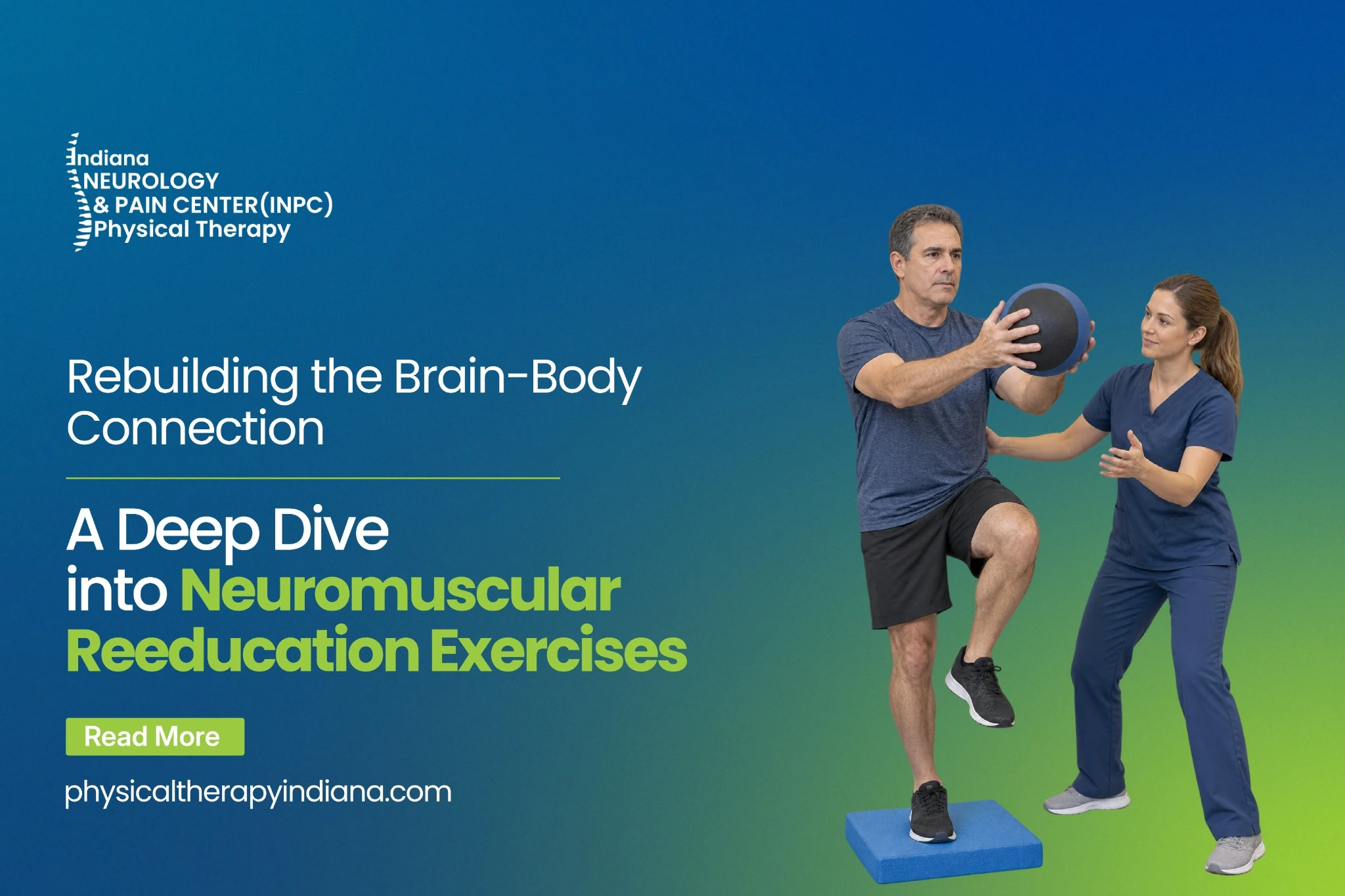
- Uneven Surface Stabilization: A patient might start by simply standing on one leg on a hard, flat clinic floor. Once they master that, the therapist introduces chaos. Standing on a squishy foam pad (like an Airex pad) or a wobble board completely alters the feedback the brain receives. The foot and ankle have to make thousands of tiny, involuntary micro-adjustments every second just to keep the person upright.
- Eyes-Closed Tandem Stance: Placing one foot directly in front of the other (like walking a tightrope) narrows the base of support. When the patient closes their eyes, the brain can no longer use the horizon to stay level. It has to rely entirely on the inner ear and the joint receptors.
2. Proprioceptive Neuromuscular Facilitation (PNF)
People rarely move in perfect, straight lines during daily life. Reaching into a high cabinet or swinging a golf club involves complex, diagonal spirals. That is exactly why proprioceptive neuromuscular facilitation stands out as such a potent method—it directly replicates real, messy human movement.
- D1/D2 Diagonal Patterns: Rather than having someone lift a dumbbell in a straight, robotic line, a therapist manually guides the limb through a sweeping, diagonal arc. Think about drawing a sword: you start at the opposite hip, pull up across the torso, and finish with the arm elevated and hand open. Guiding a joint through this kind of spiral forces an entire chain of muscles to activate together, mimicking real-world mechanics.
- Rhythmic Stabilization: Imagine holding your arm rigidly in front of you. A physical therapist then applies light, completely unpredictable nudges from varying angles. The patient must resist the pressure and keep the arm perfectly still. This teaches the joint to reflexively stiffen and protect itself against sudden outside forces.
3. Deep Core and Postural Control
A strong core has very little to do with having visible abdominal muscles. True core stability means the deep spinal muscles fire a fraction of a second before the arms or legs move, bracing the spine against sudden pulling or twisting.
- Pressure Biofeedback Training: A small, inflatable air bladder with a pressure gauge is placed under the curve of the patient’s lower back as they lie on the floor. While slowly marching their legs, the patient has to watch the gauge and keep the pressure perfectly steady. If the gauge moves, it means their pelvis is tilting and they have lost deep core control.
- Perturbation Bird-Dog: The patient kneels on all fours, extending the opposite arm and leg. The therapist then taps or lightly nudges the extended limbs. The patient must freeze their torso in place, forcing the brain to coordinate the deep multifidus muscles in the back with the transverse abdominis in the front.
4. Reactive and Dynamic Exercises
The final hurdle in physical therapy neuromuscular reeducation is preparing the body for the real world, where slips, trips, and sudden stops happen constantly.
- Drop Jumps and Deceleration: Stepping off a small box and landing on two feet sounds simple. Yet, following a joint injury, the brain tends to hesitate upon impact. This hesitation often forces the uninjured leg to absorb the brunt of the landing, or causes the injured knee to buckle slightly inward. Drilling slow, highly controlled landings teaches the nervous system how to distribute that physical shock evenly across both sides of the body again.
- Dual-Task Processing: Clinicians often introduce deliberate distractions to find out if a repaired movement habit is genuinely permanent. A patient might be asked to balance on a precarious surface while simultaneously catching a ball or counting backward from 100 by sevens. If the balance fails when the brain is distracted, the neuromuscular connection isn’t fully healed yet.
Who Benefits from This Approach?
The applications for neuromuscular reeducation physical therapy span across multiple medical disciplines.
Orthopedic patients are perhaps the most common demographic. Anyone recovering from joint replacements, ligament repairs, or severe sprains requires this intervention and neuromuscular reeducation exercises. The surgeon fixes the hardware, but the physical therapist has to reboot the software.
It is also a cornerstone of care for neurological conditions. Patients dealing with the fallout of a stroke, recovering from a traumatic brain injury, or navigating progressive diseases like multiple sclerosis rely on these methods to build fresh neural highways. Thanks to neuroplasticity, the human brain can literally rewire itself. Consistently practicing highly specific, focused movement drills leverages that exact biological trait to help recover lost motor control.
Finally, chronic pain sufferers see massive benefits. In cases of chronic lower back pain, studies routinely show that the stabilizing muscles simply fall asleep at the wheel, firing too late to protect the spine. Neuromuscular rehabilitation exercises wake these muscles up, breaking the cycle of constant mechanical irritation.
Table 2: The Timeline of Motor Recovery
| Rehab Phase | Clinical Focus | Patient Experience |
|---|---|---|
| Phase 1: Protection | Waking up inhibited muscles safely. | Movements require intense concentration. Mental fatigue is common. |
| Phase 2: Movement Integration | Getting separate muscle groups to communicate effectively so the body can handle actual daily tasks rather than just isolated clinic exercises. | You start feeling significantly more planted on your feet, and normal routines like navigating stairs or carrying groceries lose that awkward, unsteady sensation. |
| Phase 3: Automation | Training the nervous system to catch the body instantly if you slip, trip, or get bumped, bypassing conscious thought entirely. | Physical confidence peaks. Walking and moving feel natural again and happen without intense mental effort. |
Moving Forward

Naveed Javied, PT
Physical Therapist
Naveed Javied is a highly skilled physical therapist specializing in orthopedic rehabilitation. He earned his Doctor of Physical Therapy from the University of Montana, building upon his Master of Physical Therapy from Quinnipiac College. With extensive clinical experience, including specialized orthopedic care at Oakwood Annapolis Hospital, Javied focuses on helping patients effectively manage pain and restore their mobility.
Frequently Asked Questions
It shouldn’t be. Unlike heavy weightlifting that intentionally creates micro-tears in muscle tissue, these drills focus on the nervous system. Patients rarely feel muscular soreness the next day. That said, patients often leave sessions feeling incredibly mentally drained, simply because retraining the nervous system demands such heavy psychological focus.
Basic therapeutic exercise generally zeroes in on structural issues. It exists to stretch out a stiff tendon, build larger muscle fibers, or push cardiovascular limits. Neuromuscular reeducation focuses strictly on communication, timing, and movement quality.
Yes, absolutely. Medical billing systems recognize this specific approach under CPT code 97112. Both Medicare and standard commercial insurers generally cover the treatment, provided a licensed therapist documents that the intervention is medically necessary for restoring balance, kinesthetic awareness, or proper posture.
The central nervous system actually adapts to fresh stimuli rather rapidly. It is very common for patients to spot obvious improvements in their ability to balance and sense their joint positions after just two to three weeks of steady clinical work. However, making these new movement patterns completely permanent and automatic usually requires about two to three months of dedicated practice.
References
https://doi.org/10.2478/v10078-012-0011-y
https://doi.org/10.1097/wco.0000000000000974